Minimum Trace and Space Matrix - Epec
https://www.epectec.com/downloads/15-Ways-To-Design-Reliability-Into-Your-Heavy-Copper-PCBs.pdf
That's it !
Sierra Circuits - Online Stackup Designer
Stackup Designer | Sierra Circuits
Bandwidth, Rise time & Critical Length Calculator | Sierra Circuits
Problem - Paste Stencils should NOT have inside corners
Solution - All openings in the paste stencil must have outside corners.
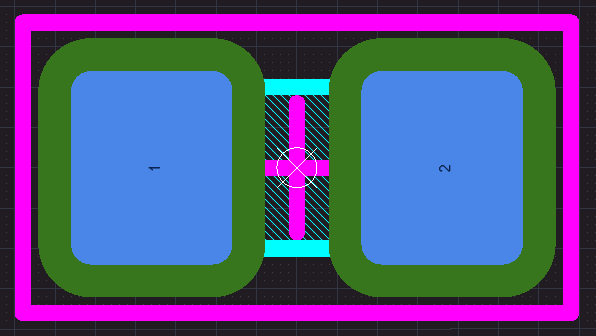
Problem - Silkscreen lines along sides of chip Resistors, Capacitors and Inductors will interfere with aqueous cleaning processes.
Solution - Remove silkscreen as shown below to allow aqueous cleaning processes to remove flux residues under chip Resistors, Capacitors and Inductors.
Problem - Silkscreen under or too close to the edge of Bottom Terminal Components.
Why ? Silkscreen registration accuracy is typically plus or minis 5mils.
Analogy:
Think about speed bumps or undulations in a parking lot or in roads near schools.
Silkscreen will be the tallest feature on the outer layers of the PCB.
These raised silkscreen lines under or near the edge of the component can cause soldering yield problems especally for small fine pitched Bottom Terminal Components (BTC).
Solution - Keep silkscreen lines 5mils away from the edges of all Bottom Terminated Components, ie, QFNs and DFNs,
Problem - Excess solder paste on BTC pads.
Why ? Excess solder will form a raised pillow and the part will teeter totter during reflow.
The part can end up having shorted pads (solder bridges) on one side or open connections.
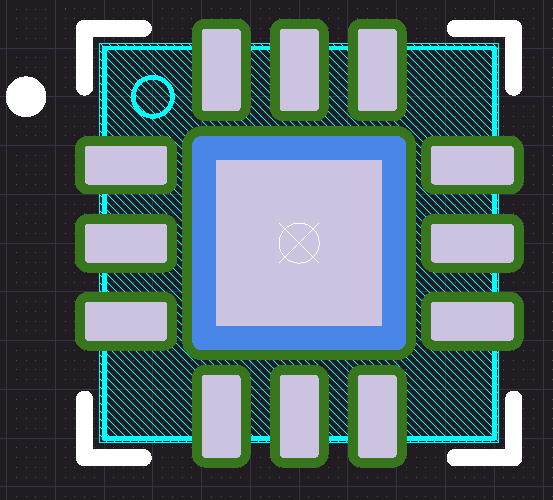
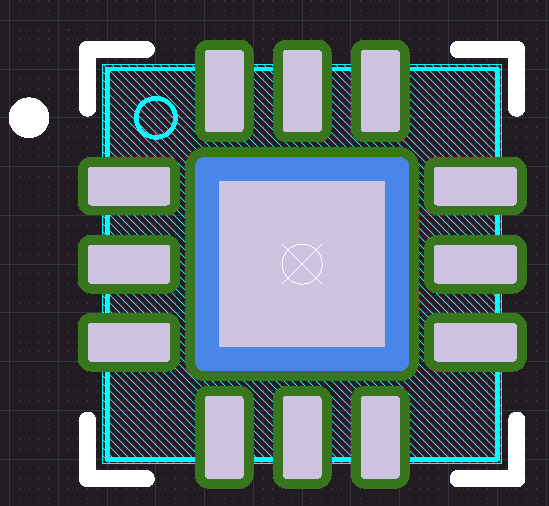
Solution - Reduce solder paste volume, to 50% to 60% of the pad's area.
Example - Tiny QFN
Example - Small DFN
Example - Small QFN with Windowed Paste
Problem - LEDs and Diodes - Pin1 should be the Cathode (K)
Example - Wrong ! Pin 2 was assigned to the Cathode.
Example - Kingbright P/N APTD1608CGCK
Note Cathode (K) is Pin 1 and Anode (A) is Pin 2
Solution - The Cathode should be assigned to Pin 1.
That's it !
High-Speed Interface Layout Guidelines (Rev. J) - Texas Instruments
Per Gemini - Google AI
There are actually two main reasons why differential signals are not always preferred for routing on the outer layers of a printed circuit board (PCB), and it has to do with the type of transmission line formed:
Microstrip vs. Stripline:
Outer layers create microstrip transmission lines, where the signal trace has a reference plane on one side (usually a power plane) and air on the other.
Differential signals rely on a consistent and symmetrical environment for optimal performance. Microstrip, due to its air exposure, introduces an asymmetry that can affect the common-mode vs. differential-mode propagation characteristics.
Controlled Impedance:
Precise control over the impedance of the transmission line is crucial for high-speed differential signals. Microstrip's impedance is more sensitive to variations in manufacturing tolerances compared to stripline.
However, there are some advantages to routing differential signals on outer layers:
Slightly Faster Signal Propagation:
Outer layers have a lower effective dielectric constant due to the presence of air. This can lead to marginally faster signal travel compared to inner layer routing.
Easier Access for Controlled-Impedance Routing Techniques:
The outer layers are more accessible for adding solder masks or prepreg layers to adjust the trace width and spacing, allowing for finer control over impedance.
In conclusion, the decision to route differential signals on outer layers depends on the specific application's priorities. For high-performance applications where signal integrity is paramount, stripline routing on inner layers with a controlled and symmetrical environment is usually preferred. However, for lower-speed applications where manufacturability and ease of access are important, outer layer routing with microstrip can be a viable option, considering the trade-offs mentioned above.
That's it !
ARC Technologies, a Hexcel Company, is the leading supplier of microwave and RF absorbing materials for commercial and defense applications.
RF Interference Control | Hexcel
Wave-X™ Near Field Absorbers | Hexcel
RF Interference Control | Hexcel
Notes:
Aluminum doesn't block magnetic waves. Magnetic waves and electromagnetic waves, though related, are different. Aluminum is effective at blocking electromagnetic waves, especially at higher frequencies like radio and light waves. This is why aluminum foil is sometimes used to block radio signals.
For magnetic waves, however, aluminum acts like air because magnetic permeability of aluminum is very close to that of air. This means magnetic waves pass through aluminum just as easily as they pass through air.
If you need to block magnetic fields, you should use materials called ferromagnetic materials like steel or iron. These materials have a much higher magnetic permeability than air or aluminum, and they can significantly weaken magnetic fields.
That's it !